

MARKET TIMING & BUYER BEHAVIOR - Why Early Spring Is the Advantage Window in Hilton Head & Bluffton
 Early spring (late February through mid-April) is the advantage window because it aligns a rising buyer pulse with the cleanest competitive landscape sellers get all year. Nationally, pending contracts tend to rise in March and peak around June, meaning demand is building before the market reaches its most crowded point.
Locally, the last five years have seen a market that has become more choice-rich for buyers and therefore more execution-sensitive for sellers. From 2021 to 2025, year-end inventory climbed materially across all three core segments we track here (Bluffton 29910/29909, Hilton Head detached, Hilton Head condos/villas). Median prices remain resilient, but list-to-sale ratios have softened, and days on market have become more volatile. In this environment, listing earlier in the cycle reduces the odds of ending up chasing the market with price reductions and extended days on market.
What the last five years tell us locally
All local metrics below come from the one-page “Local Market Update” reports produced using MLS data, provided by REsides, Inc. and published through Hilton Head Area Association of REALTORS®, sponsored by South Carolina REALTORS®. The reports note that the median price and the percent of list price received do not account for concessions and/or down payment assistance.
Five-Year Annual Trends
Bluffton 29910/29909 (annual, year-to-date as of December)

Hilton Head detached homes (annual, year-to-date as of December)
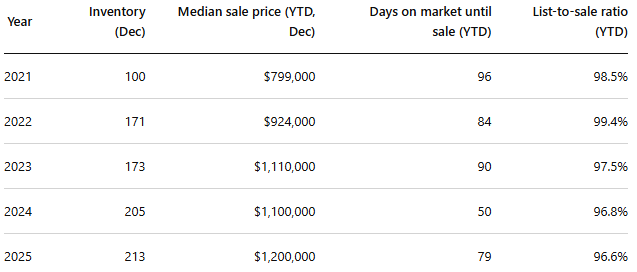
Hilton Head condos/villas (annual, year-to-date as of December)

What this means for sellers: inventory is up versus the tightest years, and list-to-sale ratios are down off peak. That combination shifts advantage toward the best-prepared listings and the best-timed launches, not the “we’ll see what happens” listings.
Early spring is the leverage window
Early spring here means late February through mid-April, and it matters because buyer intent is rising while competition is still sorting itself out. Nationally, the National Association of REALTORS® notes pending home sales typically rise in March and peak in June, a classic ramp into the prime transaction months.
At the same time, research from Realtor.com consistently finds a mid-April “sweet spot” nationally where buyer demand is elevated, and competition is lower. Their 2025 analysis highlights that the week of April 13–19 historically draws more views per listing than a typical week.
Local seasonal snapshot
Below is a clean, local comparison between March 2025 (early spring) and July 2025 (deep summer). This is a month-to-month snapshot, not a multi-year seasonal average. It is still valuable because it shows how quickly seller leverage can change once the market gets crowded.
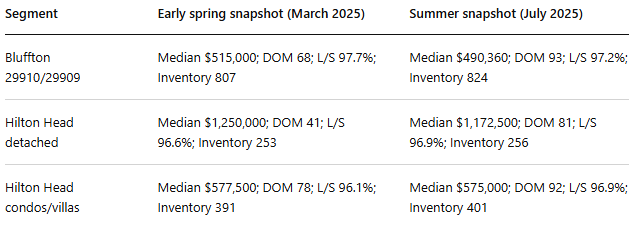
The pattern most sellers should care about is not a tiny wiggle in the list-to-sale ratio. It’s the jump in days on market once summer inventory piles up. More days means more negotiating leverage for buyers and more temptation for sellers to cut price.
Buyer profiles and behavior shifts that matter to sellers
Our buyer pool is heavily influenced by retirees, second-home buyers, and relocations. The demographics support that: Hilton Head Island’s population is 39.2% age 65+, and Bluffton’s is 24.6% age 65+. Beaufort County overall is 29.6% age 65+.
National buyer financing data reinforces why sellers must assume a more analytical, option-rich buyer. In the NAR buyer/seller highlights, 26% of buyers paid all cash (an all-time high), and down payments were elevated (median 18% overall; 23% for repeat buyers).
That same report also frames what sellers actually prioritize when choosing representation: competitive pricing and marketing that reaches buyers effectively, not gimmicks.
For early spring, this buyer profile matters because: A meaningful share of buyers are financially capable and patient. They will wait for the best-positioned home, then move decisively when it appears.
Sellers who miss the early spring window often end up negotiating from a weaker position because longer market time gives buyers room to be choosy and aggressive.
Seller strategy that wins in early spring
Sellers don’t need hype. They need a plan that reduces buyer objections and concentrates demand.
Practical execution priorities
Pricing: price to be the best-value option in your lane on day one, not the “maybe they’ll negotiate us down” option on day thirty. Longer market times shift leverage to buyers.
Presentation: staging is not decoration; it is risk management. In NAR’s 2025 home staging findings, 49% of listing agents said staging reduced time on market, and 29% reported it increased the dollar value offered (most commonly by 1% to 10%).
Marketing: sellers consistently want marketing exposure and competitive pricing advice from their agent, and agents commonly use MLS, signage, open houses, and major web distribution as part of the marketing mix.
Actionable seller checklist
- Complete pre-list repairs and disclosure prep; remove preventable inspection surprises.
- Declutter to “model home simple,” then stage or style for high-quality photography.
- Professional photography and a clean, conversion-focused digital launch (strategic ads plus retargeting).
- Launch week includes at least one open house (where appropriate) and concentrated broker outreach.
- Review showing feedback quickly; address friction (access, objection points) before adjusting price.
Recommended marketing calendar for an early-spring listing
- Weeks 10–7 (late Dec to mid-Jan for late Feb; or Jan for March): pricing analysis, repairs scoped, staging consult, vendor booked.
- Weeks 6–4: repairs completed, paint and punch list, deep clean, landscaping refreshed.
- Weeks 3–2: staging installed, photography and video produced, listing narrative and digital ads built.
- Week 1 (go-live): launch, open house, agent outreach, daily feedback loop.
- Weeks 2–3 active: second open house or targeted event; tighten negotiation posture while the listing is “new.”
- Weeks 4–6 active: if results lag, adjust price with data and urgency, not emotion.
Local case examples that show the cost of waiting
These are anonymized, MLS-based market-environment examples using the local monthly reports (not individual property files). They show the selling conditions a typical listing faced in early spring versus summer.
Case example: Bluffton 29910/29909, March vs July 2025
March 2025: median $515,000; DOM 68; inventory 807.
July 2025: median $490,360; DOM 93; inventory 824.
Seller takeaway: the later you list on a fuller shelf, the more time buyers have to compare and negotiate.
Case example: Hilton Head detached, March vs July 2025
March 2025: median $1,250,000; DOM 41.
July 2025: median $1,172,500; DOM 81.
Seller takeaway: When marketing time doubles, buyers start asking, “What’s wrong with it?” even when nothing is wrong.
Case example: Hilton Head condos/villas, March vs July 2025
March 2025: median $577,500; DOM 78; inventory 391.
July 2025: median $575,000; DOM 92; inventory 401.
Seller takeaway: condos compete on total package (condition, rules, fees, assessments). More inventory amplifies every objection.
Posted by Paige Rose on
Leave A Comment